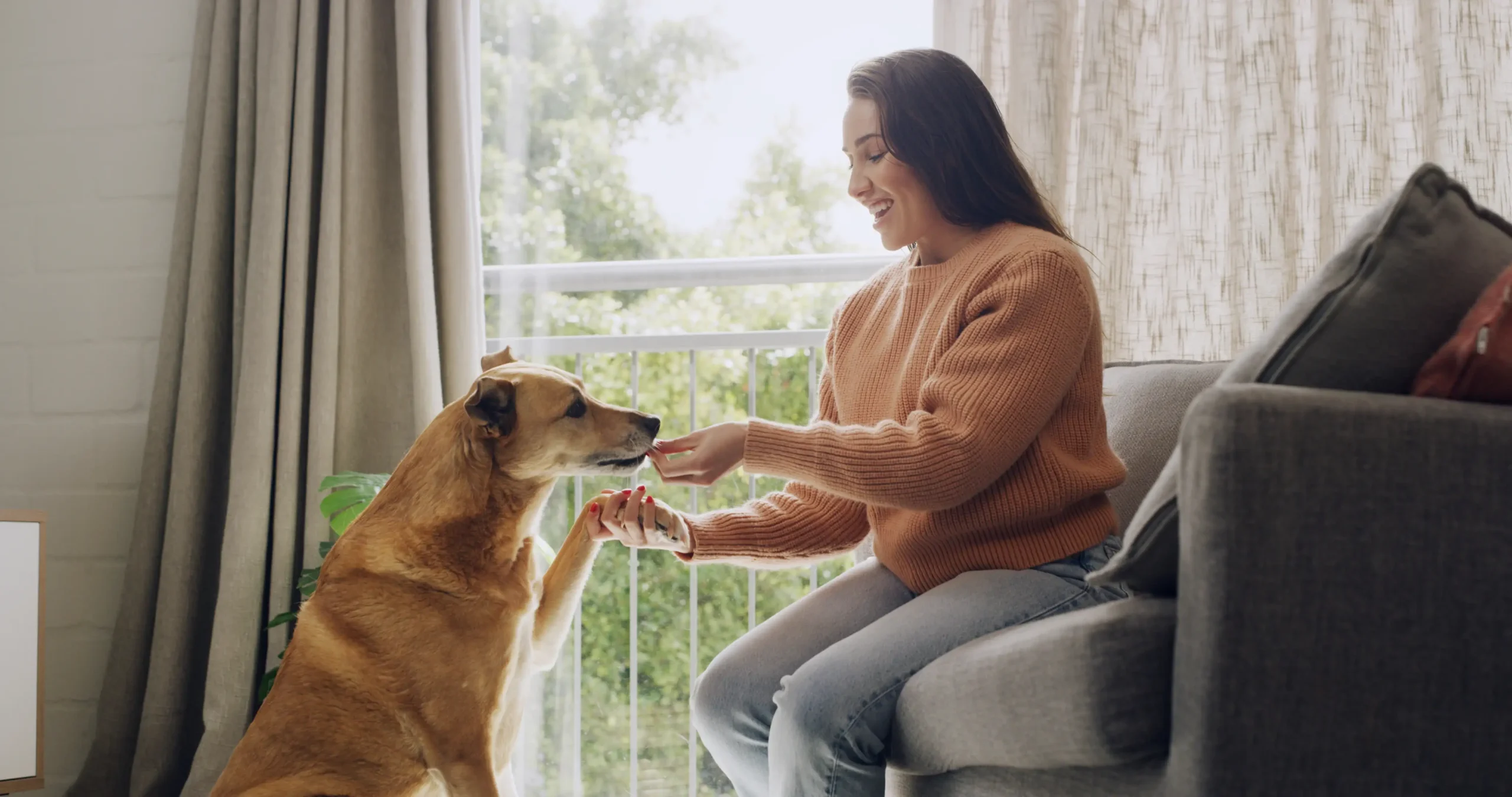
Obedience Training · West Palm Beach
Dog Obedience Training in West Palm Beach
Private one-on-one lessons where you learn to handle your own dog — so the obedience belongs to you, not to a trainer who goes home.
- 4 lessons $650
- 8 lessons $1,000
- E-collar & leash included
Lessons, not classes
These are private sessions. No group class, no waiting your turn while six other dogs bark, no curriculum built for the average of a room. The lesson is about your dog and the specific things your dog does.
The structure matters as much as the content. Each lesson introduces commands, you practise them with your dog under supervision, and then you take homework away. The dog learns the command; you learn the timing. The second part is the one that decides whether it lasts.
The three ways in
Starter
$375An introductory session that introduces your dog to e-collar training. Useful if you want to see the method work before committing to a full package.
Basic Obedience
$650Come, sit and extended sit, place and extended place, loose-leash heel, down and extended down, and "off" to shut down unwanted behavior.
Basic & Advanced
$1,000The first four lessons cover the basics. The last four add distance obedience, focused heel, "watch", "through", "front" and more.
Every package includes the e-collar and training leash.
What "advanced" means in practice
Advanced obedience is mostly about distance and duration. A dog that will hold a down at fifty yards with something interesting happening nearby is operating at a completely different level from a dog that downs at your feet in the kitchen. The advanced lessons add extended distance work, a focused heel where the dog watches you the whole time, and positioning commands like "through" and "front".
Most owners who start with four lessons and enjoy the process end up wanting the second four. If you already know that is you, the eight-lesson package is the cheaper route.
How the lessons are actually taught
Three tools do most of the work, and they are used together rather than chosen between. Markers tell the dog the exact instant it got something right, which is the part owners usually get wrong by seconds. Praise and reward pay the behavior so it is worth repeating. Low-level e-collar communication provides a consistent signal that still reaches the dog at a distance, where voice and leash do not.
The published research on training methods is worth knowing about rather than hiding from. Studies comparing reward-based and aversive-based approaches have found reward-based training performs at least as well on obedience outcomes and better on welfare measures, and a large controlled trial of remote e-collars found that outcomes depend heavily on the setting used, a pre-warning cue, and the skill of the trainer — not on the device itself. That is precisely why we teach the meaning of the signal before we ever use it, and why we work at the lowest level your individual dog responds to.
If you would rather not use one at all, say so. There are programs we can run without it.
What you are expected to do between lessons
This is the part that decides your result, and it is worth being honest about before you book. Private lessons are not a drop-off service. Between sessions you are expected to run short, frequent practice — a few minutes several times a day beats one long weekend session — and to apply the same rules the rest of the household applies.
- Short daily reps, not marathon sessions
- Everyone in the house using the same words and the same criteria
- Practising in progressively harder places, not just the living room
- Telling us honestly what is not working, so we fix it at the next lesson rather than three lessons later
Owners who do this get the result the programme is designed for. Owners who do not generally end up wanting a board and train instead, which is a perfectly reasonable outcome — it is just more expensive than doing the homework.
Where this pays off in Palm Beach County
The county asks that dogs at its parks stay under voice control — its phrasing is that the dog comes when called — and be restrained within six feet of the handler when entering and leaving. Those are the exact moments where an untrained dog embarrasses its owner, and they are the moments this curriculum is built around.
Results vary by dog. Major behavioral issues such as dog or human aggression cannot be guaranteed to be eliminated — our programs give you control and a clear plan to manage them.
About the method
Off Leash K9 Training was founded in 2010 by Nick White, a United States Marine Corps veteran and former United States Secret Service agent. White served in Fallujah during Operation Phantom Fury, where his unit relied on trained dogs to detect explosives and contraband, and later carried out Secret Service protective details including Presidents George W. Bush and Barack Obama and Vice President Dick Cheney.
He left the Secret Service in 2010 to open Off Leash K9 Training in Woodbridge, Virginia, and is the author of Raising the Perfect Dog: Secrets of Law Enforcement K9 Trainers (2011). He has since appeared as the expert trainer on A&E's America's Top Dog, and served on the board of the Prince William County Humane Society, helping establish its Warrior Buddies programme pairing shelter dogs with returning veterans free of charge.
The obedience curriculum used at Off Leash K9 Training, West Palm Beach is the one he built.
Sources
- Cooper, J.J., Cracknell, N., Hardiman, J., Wright, H., Mills, D. (2014). “The welfare consequences and efficacy of training pet dogs with remote electronic training collars in comparison to reward based training.” PLOS ONE. PMC4153538
- Vieira de Castro, A.C., Fuchs, D., Morello, G.M., Pastur, S., de Sousa, L., Olsson, I.A.S. (2020). “Does training method matter? Evidence for the negative impact of aversive-based methods on companion dog welfare.” PLOS ONE. PMC7743949
- Nick White (dog trainer), Wikipedia; Off Leash K9 Training, About.
Obedience questions
What is the difference between the four and eight lesson packages?
Four lessons ($650) cover the basic command set. Eight lessons ($1,000) add the advanced work — distance obedience, focused heel and positioning commands. Both include the e-collar and training leash.
Do I need to be at every lesson?
Yes, and that is the point. These are private lessons for you and your dog together. Off Leash K9 Training teaches you the handling and timing, because a dog that only responds to the trainer has not solved your problem.
Is my dog too old for obedience training?
Almost certainly not. Regardless of breed, size or age, most dogs can be trained to a high standard of obedience. Call Off Leash K9 Training and describe your dog — we will tell you honestly what to expect.
Can I start small and add more lessons later?
Yes. The Basic Obedience Starter is a single lesson at $375 that introduces your dog to e-collar training. Many owners use it to see the method before booking a full package.